
Routing a lead should not require another research tab.
Revenue teams reconcile incoming inquiries, existing accounts and routing rules before creating a useful next action. NodeFox connects the input, reference checks and human decision in one executable workflow.
Interpret the input. Establish the facts. Control the action.
AI interprets
- Company and buying request parsed
- Need: multi-site maintenance
- Requested follow-up: this week
Systems provide context
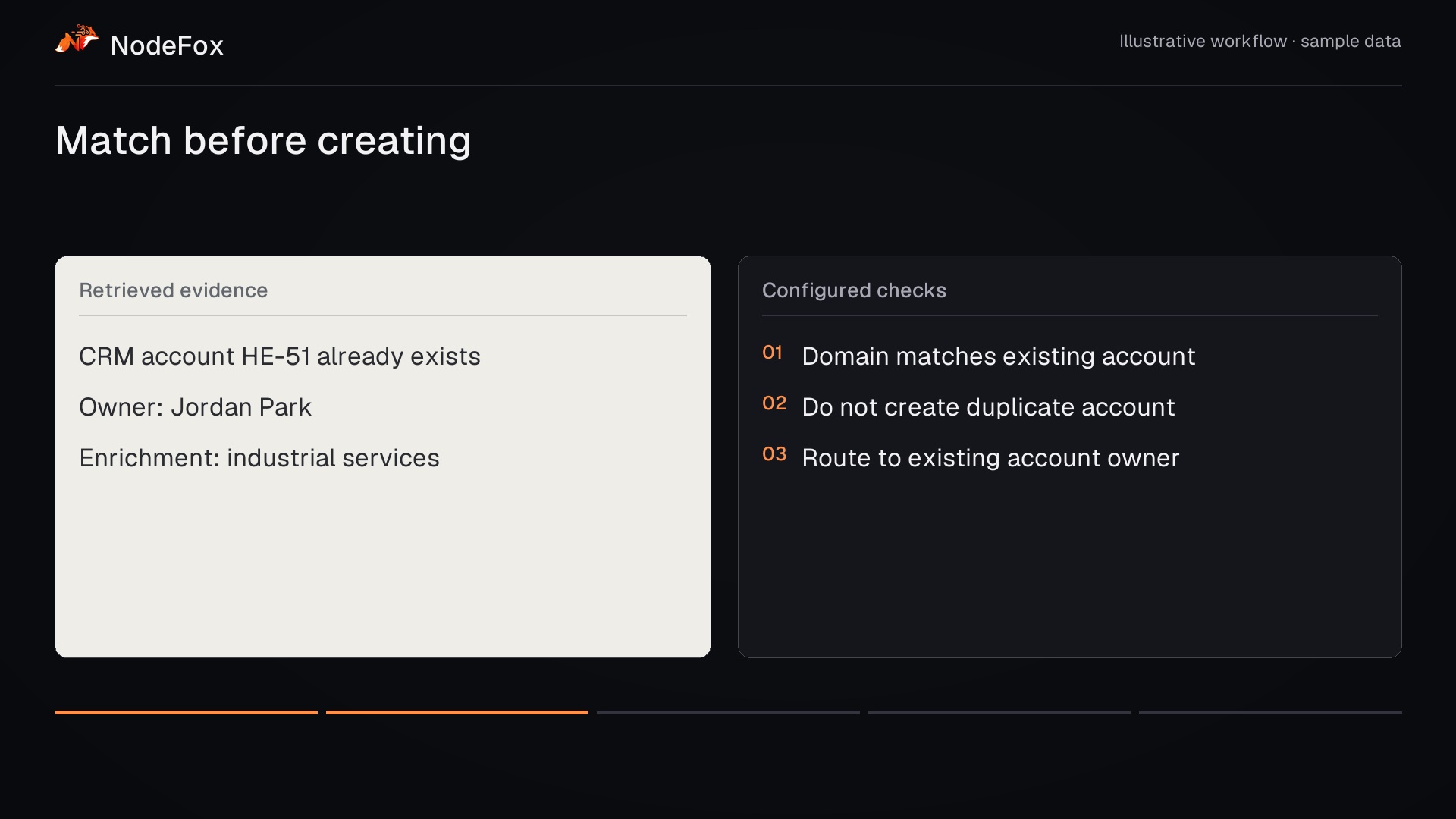
- CRM account HE-51 already exists
- Owner: Jordan Park
- Enrichment: industrial services
Code applies exact checks
- Domain matches existing account
- Do not create duplicate account
- Route to existing account owner
People retain the decision
- Owner reviews qualification summary
- Accept follow-up task
- No outreach sent by this example
What proceeds—and what waits
A confident account match and routing rule assign the inquiry and prepare the task.
Ambiguous matches or unclear territory ownership go to sales operations before the CRM update.
Raw input → usable output
Give the owner a useful handoff, not a duplicate record.
The inquiry reaches the right owner on the existing account, with a useful follow-up task instead of another duplicate CRM record.
- Input 1
- Inquiry INQ-904 · Harbor Engineering
- Input 2
- Domain: harbor.example
- Input 3
- Interest: regional service contract
- Input 4
- Territory: Northeast
HE-51 · inquiry linked
- duplicate created
- No
- follow up task
- scope service requirement
- outreach sent
- No
Decision attached
Accept follow-up task
Source references and configured checks accompany the result.
Inspect the structured record
{
  "account_id": "HE-51",
  "inquiry_id": "INQ-904",
  "duplicate_created": false,
  "follow_up_task": "scope_service_requirement",
  "outreach_sent": false
}Synthetic sample files with inputs, checks and decisions. System updates require configured access and authorization. Documents and reports depend on the chosen Writer format and template.
Give the owner a useful handoff, not a duplicate record.
Transcript and demonstration details
Illustrative execution, not a customer deployment. Narration is AI-generated. Actions and outputs depend on workflow configuration.
- 0–8s · An inquiry may belong to an existing account
Harbor Engineering asks about a regional service contract. Creating a new account would split its history.
Inquiry INQ-904 · Harbor Engineering · Domain: harbor.example · Interest: regional service contract · Territory: Northeast
- 8–18s · Match before creating
The domain matches an existing CRM account. Enrichment provides context, while exact identity rules prevent a duplicate record.
Domain matches existing account · Do not create duplicate account · Route to existing account owner
- 18–27s · Turn context into accountable routing
The workflow combines the inquiry, account lookup and territory rules, then carries the summary to the existing owner.
Inquiry form · CRM · Configured enrichment API
- 27–36s · Give the owner a useful next step
Jordan reviews the qualification summary and accepts the follow-up task. This example sends no outbound message.
Owner reviews qualification summary · Accept follow-up task · No outreach sent by this example
- 36–45s · A linked inquiry and an owned task
The CRM record retains the source and routing reason. The next action is to scope the service requirement with the customer.
HE-51 · inquiry linked · Task: scope service requirement · Owner: Jordan Park · Source and routing reason retained
What could sales operations release?
Editable hypothetical example · USD
What could less coordination be worth?
Change four assumptions to estimate annual capacity. These are example inputs, not customer results. Calculations stay in your browser.
- Annual capacity potentially released
- 1,040 hours
- Annual labor-capacity equivalent
- $52,000
- Reduction in hands-on time
- 66.7%
7,800 cases / year × 8 minutes removed per case ÷ 60. Includes eligibility, exception effort and rework when entered.
Capacity is not automatically cash savings. Value depends on how the released time is used and what the workflow costs to operate.
Measure the work removed—and the quality that remains.
- Research minutes per inquiry
- Duplicate record rate
- Time to accountable owner
Start with one sales operations process.
Access, ownership and acceptance
Read account identifiers, ownership and routing rules. Scope account notes and task creation separately from outbound communications.
- Inquiry form
- CRM
- Configured enrichment API
Name the process owner and technical operator. Agree acceptance criteria and costs before implementation. A successful evaluation leads to recurring platform use; proven connections and checks can support the next workflow. When feasibility is already established, scope production directly.
Is this work your team keeps coordinating?
Bring the current steps, systems and approximate volume. Discuss sales operations, what would remain human-owned and whether a paid implementation makes sense.