
Hand your examiners cases that are ready to decide.
NodeFox classifies each case’s attachments, pulls the policy and claim record, and checks the file for missing or conflicting evidence. Complete files go to the decision queue. Gaps and contradictions reach a reviewer with the source pages side by side. Built on NodeFox’s executable workflow platform.
One workflow, 3 different cases.
Pick a case to see which steps run, what a reviewer is shown and what gets written.
Synthetic example · Case file received
Case readiness review
Arrives
Case 60418 · Ridgefield Cabinetry · water damage
- Loss date
- Nov 2, 2026
- Policy period
- Jan 1 – Dec 31, 2026
- Repair estimate
- $18,450
- Photos and notes
- Attached
Runs
Claim form and attachments from the intake inbox, a portal export or a watched folder.
Claim form, estimates, invoices, reports and correspondence: dates and amounts into a typed record.
Case system API: coverage period, limits and prior claims on the policy.
Exact rules in code: required evidence present, dates inside coverage, amounts agree across documents.
Every required document is present, and dates and amounts agree.
The missing or conflicting item, the documents involved and their page references.
Accept, request evidence, or escalate to a senior examiner.
Readiness and the summary written back, only after a pass or the reviewer’s decision.
Which checks ran, what was flagged, who decided.
Examiners spend their time on the decision. Who sent what, which dates disagree and what’s still missing is already worked out.
Result
Written
Case marked ready
- Case 60418 moved to the decision queue
- Evidence summary attached for the examiner
- No reviewer time used in preparation
Work coordinated: input gathering, system lookups, repeated checks and approved updates. Select a step to inspect its role.
Human-owned: process rules, exception judgment and authorization. Synthetic records and transitions; no model calls or live system writes.
Prepare the evidence before asking for judgment.
The same work, with the checking done first.
- Today
An examiner opens every attachment to work out what the file contains.
With NodeFoxAttachments are classified and indexed when the case arrives.
We measurePreparation minutes per case
- Today
Missing evidence is noticed mid-review and the file goes back to the queue.
With NodeFoxGaps are flagged before the case reaches an examiner.
We measureMissing-evidence rate and backlog age
- Today
Contradictions between documents depend on someone spotting them.
With NodeFoxDates and amounts are cross-checked on every file, with page references.
We measureConflicts caught before decision versus after
- Today
Nobody can say later why a file was treated as complete.
With NodeFoxEvery readiness decision is attached to the run that made it.
We measureReopen rate against an audited sample
Raw input → usable output
Prepare better cases while preserving accountable judgment.
A specialist receives a complete evidence bundle and the reviewer’s referral, without mistaking case preparation for a coverage determination.
- Input 1
- Case CA-411 · equipment damage
- Input 2
- Policy: PL-290
- Input 3
- Incident date: Oct 27
- Input 4
- Repair estimate: $3,850
CA-411 · specialist referral
- Evidence bundle complete
- Reviewer decision recorded
- Case owner notified in sample flow
Decision attached
Request specialist assessment
Source references and configured checks accompany the result.
Inspect the structured record
{
  "case_id": "CA-411",
  "policy_id": "PL-290",
  "evidence_complete": true,
  "outcome": "specialist_referral",
  "coverage_determined": false
}Synthetic sample files with inputs, checks and decisions. System updates require configured access and authorization. Documents and reports depend on the chosen Writer format and template.
Prepare better cases while preserving accountable judgment.
Transcript and demonstration details
Illustrative execution, not a customer deployment. Narration is AI-generated. Actions and outputs depend on workflow configuration.
- 0–8s · Prepare the case before the decision
An equipment-damage case includes a policy and repair estimate. An inspection photo is initially missing.
Case CA-411 · equipment damage · Policy: PL-290 · Incident date: Oct 27 · Repair estimate: $3,850
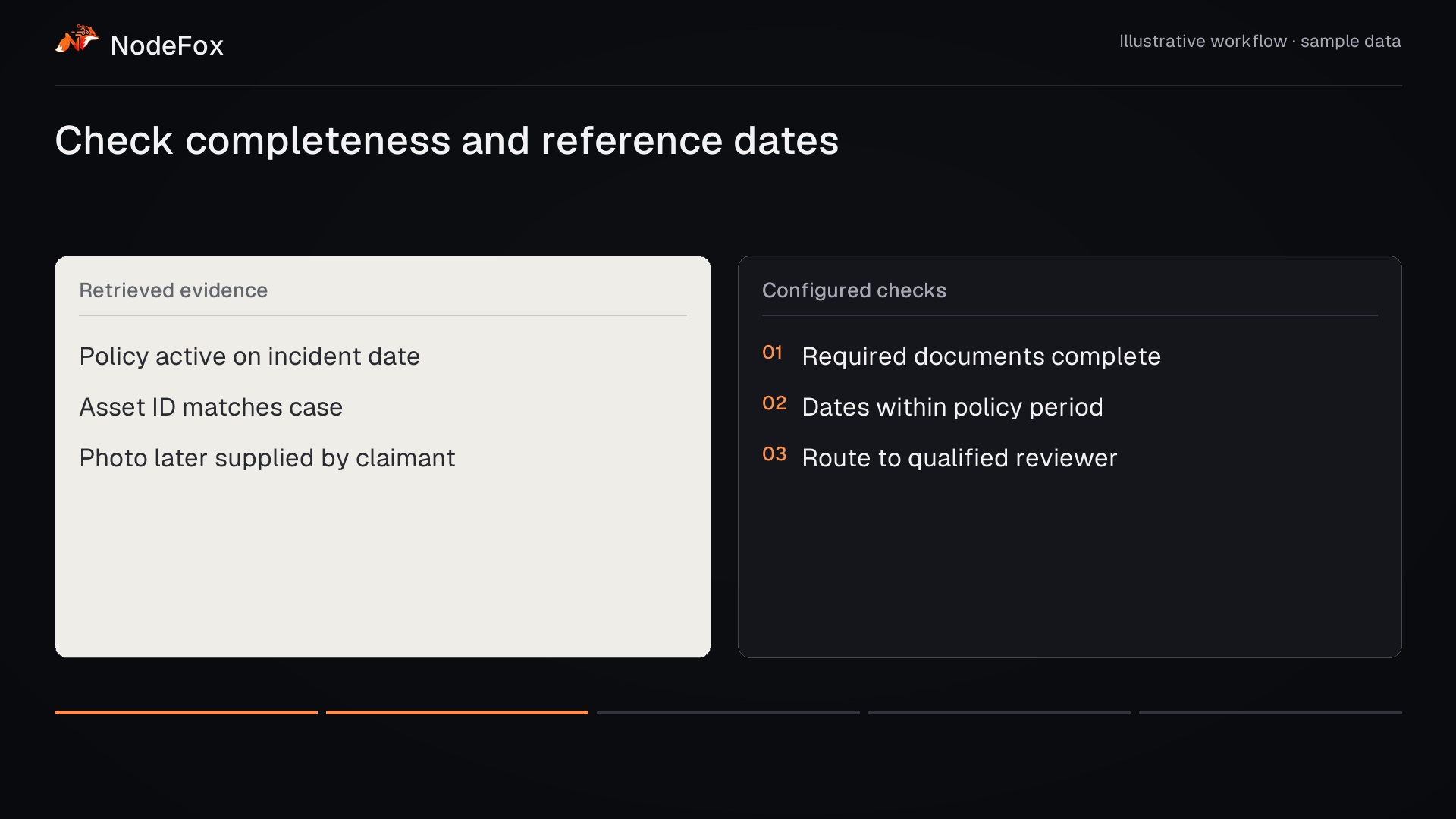
- 8–17s · Check completeness and reference dates
The workflow identifies missing evidence and checks the policy period. When the photo arrives, the review package can proceed.
Case CA-411 · equipment damage · Policy: PL-290 · Incident date: Oct 27 · Repair estimate: $3,850
- 17–27s · Interpret documents inside a controlled process
AI summarizes the material. Readers retrieve policy context. Code applies completeness rules before routing to a qualified reviewer.
Case intake · Policy records · Document repository
- 27–36s · Keep the determination with the reviewer
The reviewer requests specialist assessment. The workflow records this referral without making an automated coverage determination.
Reviewer sees evidence summary · Request specialist assessment · No automated coverage determination
- 36–46s · A review-ready specialist referral
The case output contains the complete evidence bundle, accountable owner and recorded decision. The next reviewer receives the context.
CA-411 · specialist referral · Evidence bundle complete · Reviewer decision recorded · Case owner notified in sample flow
Value the preparation. Preserve the judgment.
Editable hypothetical example · USD
What could less coordination be worth?
Change four assumptions to estimate annual capacity. These are example inputs, not customer results. Calculations stay in your browser.
- Annual capacity potentially released
- 1,802.7 hours
- Annual labor-capacity equivalent
- $90,133
- Reduction in hands-on time
- 52%
8,320 cases / year × 13 minutes removed per case ÷ 60. Includes eligibility, exception effort and rework when entered.
Capacity is not automatically cash savings. Value depends on how the released time is used and what the workflow costs to operate.
Your systems stay the system of record.
- Claims intake inbox or portalreadEmail attachments, portal exports or files in a watched folder.
- Case system — policy, claim history, statusread + writeThrough its API. Writes are limited to readiness and the summary, and gated.
- Evidence checklist by claim typereadA maintained table of required documents and tolerances.
- Team email or chatwriteNotify the reviewer or examiner. Optional.
People keep the decisions that matter.
Case handler
Senior examiner
Process owner
Start with one claim type
Pick the claim type with the most files sent back for missing evidence. We run its real (or anonymised) cases through the checks, measure against your current preparation and decide on production from the results.
Attachment classification and completeness checks for that claim type
Evidence summaries and the reviewer step
Case system read access, plus a gated write path once you approve it
A baseline-versus-pilot scorecard
- Minutes per case
- Hands-on preparation time from receipt to decision-ready, by claim type.
- Preparation versus decision effort
- Share of examiner time spent assembling the file rather than deciding it.
- Missing-evidence rate
- Share of cases flagged for a missing document, by document type.
- Reopen rate
- Cases reopened or sent back after a decision, checked against an audited sample.
Questions operations leaders ask
Our case system already tracks status.
No two case files look alike.
Does it make coverage decisions?
Case files contain sensitive personal information.
For the technical review.
Which case files bounce back most often?
Bring a case that came back incomplete. We’ll discuss evidence preparation, examiner decisions and the scope of a useful first workflow.