
Keep your systems. Automate the work between them.
NodeFox turns recurring intake, checks, reconciliation and approvals into executable workflows. Connect AI, applications and people so your team spends less time gathering, copying and coordinating—and more time on the decisions that need them.
Pick the workflow closest to yours.
Each interactive illustration follows distinct routine, conflicting and incomplete cases through the same process.
Synthetic example · Purchase order received
PO exception review
Arrives
PO 48213 · Halvorsen Supply
- SKU 1108-B
- 240 units @ $4.12
- Contract price
- $4.12
- On hand
- 1,960 units
- Ship by
- Nov 14
Runs
PDF, EDI export or email attachment arrives.
Customer, SKUs, quantities, unit prices and ship date into a typed record.
ERP API: contract price, on-hand quantity and credit status.
Exact rules in code: price within tolerance, stock covers quantity, required fields present.
Every line matches contract price and available stock.
The line in question, the contract price, stock position and source document.
Approve as priced, correct, or hold and contact the customer.
Only after the match or the reviewer’s approval.
Which checks ran, what was flagged, who decided.
Your team sees the discrepancy and the records behind it. Nobody re-assembles the same context from five screens for every order.
Result
Written
Sales order created
- SO-77104 written to ERP
- No reviewer time used
- Checks and source attached to the run
Work coordinated: input gathering, system lookups, repeated checks and approved updates. Select a step to inspect its role.
Human-owned: process rules, exception judgment and authorization. Synthetic records and transitions; no model calls or live system writes.
- Today
People gather context from records, files and messages.
With NodeFoxConfigured steps assemble the information needed for the case.
We measureHands-on preparation time per case
- Today
Every exception starts another investigation or handoff.
With NodeFoxChecks identify the discrepancy and carry its context to the reviewer.
We measureException resolution time and repeat touches
- Today
Someone rekeys the decision into the next system.
With NodeFoxAn approved branch updates the destination through its API or file interface.
We measureRework and cases completed without manual rekeying
Value the handoffs between systems.
Editable hypothetical example · USD
What could less coordination be worth?
Change four assumptions to estimate annual capacity. These are example inputs, not customer results. Calculations stay in your browser.
- Annual capacity potentially released
- 1,950 hours
- Annual labor-capacity equivalent
- $87,750
- Reduction in hands-on time
- 60%
13,000 cases / year × 9 minutes removed per case ÷ 60. Includes eligibility, exception effort and rework when entered.
Capacity is not automatically cash savings. Value depends on how the released time is used and what the workflow costs to operate.
One workflow, measured, then a production decision.
A paid pilot establishes fit against representative cases. If feasibility is already established, an enterprise agreement can proceed directly with defined scope and ownership.
- 01
Map one workflow
A conversation on what arrives, what gets checked, where exceptions appear and who signs off.
- 02
Scope and baseline
Agree the inputs, systems, review points and the current numbers we will measure against.
- 03
Paid pilot
The workflow runs on your real or anonymised cases, with a written scorecard at the end.
- 04
Production and the next one
Agree operating ownership, recurring platform and support scope. Measure use and value, then evaluate the next workflow.
See the checks your team can stop repeating.
Transcript and demonstration details
Illustrative execution, not a customer deployment. Narration is AI-generated. Actions and outputs depend on workflow configuration.
- 0–9s · Two lines. One price discrepancy.
An order requests eighty filters and twenty valves. One line matches the contract; the other needs a price decision.
PO-5824 · Acorn Industrial · Line 1: 80 filters at $42 · Line 2: 20 valves at $95 · Requested ship date: Nov 12
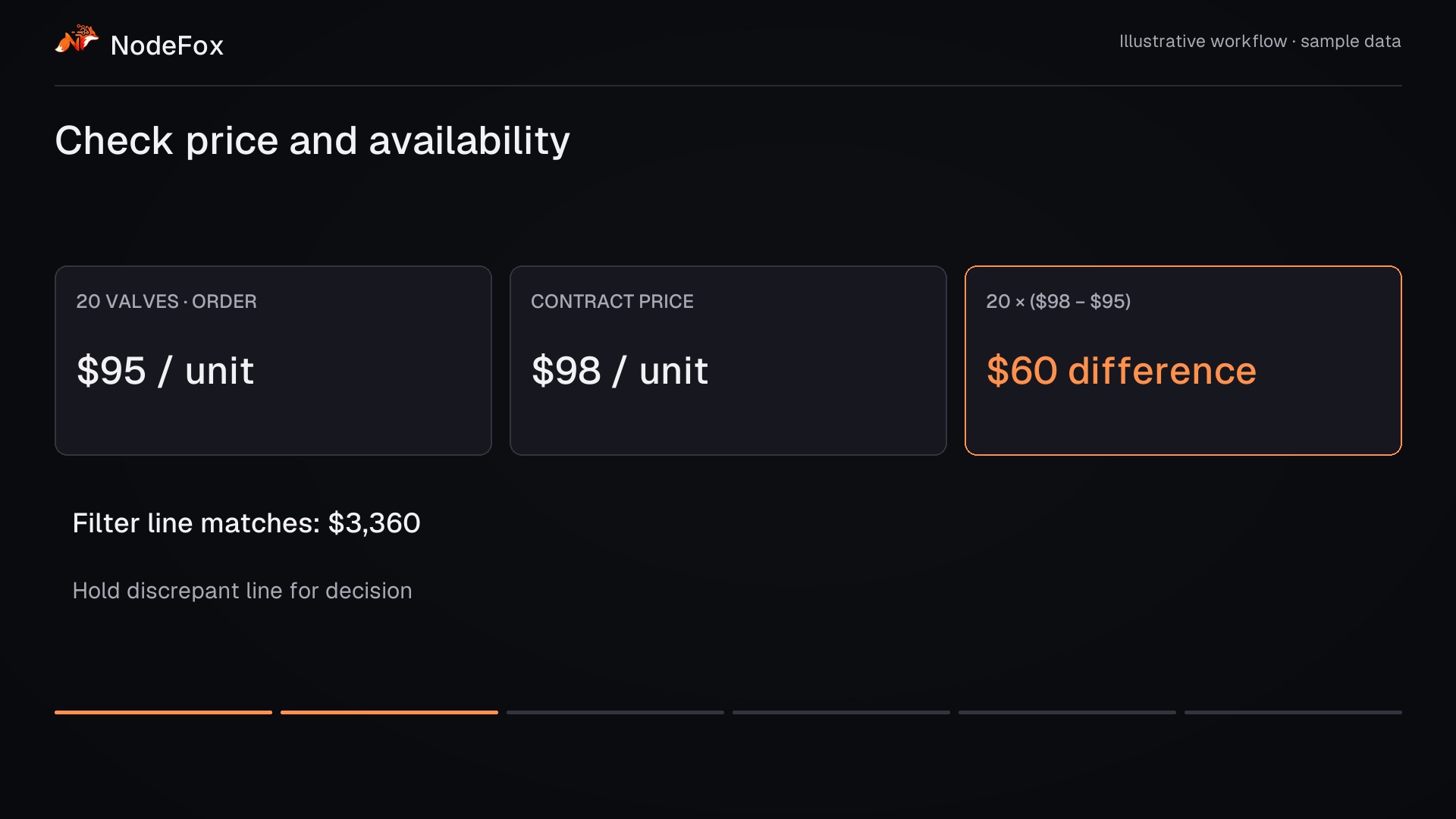
- 9–17s · Check price and availability
Readers retrieve stock and contract prices. Exact checks identify the three-dollar difference on each valve.
Filter line matches: $3,360 · Valve price differs by $3 · Hold discrepant line for decision
- 17–26s · Keep the clean line moving
The graph separates line validation from authorization. The order desk receives the discrepancy with its reference price.
Order inbox · ERP price book · Inventory API
- 26–34s · Authorize the corrected price
The reviewer approves ninety-eight dollars per valve. Only the authorized lines can proceed to the order output.
Order desk sees contract evidence · Approve current valve price: $98 · Release both authorized lines
- 34–43s · An approved order—not another handoff
The prepared order totals five thousand, three hundred and twenty dollars. Its price decision stays attached for downstream fulfillment.
SO-8126 · approved order · 80 filters + 20 valves · Order value: $5,320 · Price decision linked to order
- 43–52s · Trace each line to its source
The run record connects extracted lines, checks and approval. Measure handling time and rework against the current process.
PO-5824 · Acorn Industrial · Line 1: 80 filters at $42 · Line 2: 20 valves at $95 · Requested ship date: Nov 12
What your team needs to know.
“We already have an ERP and a CRM.”
“Our exceptions are never identical.”
“We can’t let AI change records.”
“Who maintains this?”
“What happens when it breaks?”
Which workflow would you take off your team’s plate first?
Bring a typical case and where your team loses time. We’ll discuss what could run automatically, what stays human-owned and whether the value warrants a scoped implementation.