
Get new clients live without chasing the same missing forms.
Configure a NodeFox workflow to check intake documents against the signed scope and CRM record. Prepare complete accounts for delivery; send gaps and conflicting details to the account lead for a decision. Built on NodeFox’s executable workflow platform.
One workflow, 3 different cases.
Pick a case to see which steps run, what a reviewer is shown and what gets written.
Synthetic example · Onboarding packet received
Client intake review
Arrives
Packet CL-2291 · Marrow & Teague Logistics
- Signed MSA
- Received · signed Nov 3
- Tax form
- Entity name matches
- Banking authorization
- Received
- Scope
- Payroll support, 2 sites
Runs
Emailed attachments, a portal upload or files in a watched folder.
Agreement, scope, tax form, banking authorization: key fields into a typed record.
CRM API: legal entity, contracted services and the documents that scope requires.
Exact rules in code: every required form present and signed, details consistent across documents.
All required documents are present, signed and consistent with the CRM record.
What’s missing or conflicting, which document it belongs in, and the source pages.
Proceed, request the item from the client, or escalate to the engagement owner.
Written to the CRM and handed to delivery, only after a complete check or sign-off.
Which checks ran, what was missing, who decided.
Your account lead sees what’s missing and why it matters. Nobody re-reads the whole packet to find the one form that isn’t there.
Result
Written
Client record created
- CL-2291 written to the CRM
- Handoff sent to the payroll delivery team
- Checks and source documents attached to the run
Work coordinated: input gathering, system lookups, repeated checks and approved updates. Select a step to inspect its role.
Human-owned: process rules, exception judgment and authorization. Synthetic records and transitions; no model calls or live system writes.
Keep the packet and the decision in the same process.
The same work, with the checking done first.
- Today
Someone opens every attachment and ticks a checklist by hand.
With NodeFoxDocuments are classified and checked against the scope’s requirements on arrival.
We measureHandling minutes per packet
- Today
Gaps surface days later, when delivery can’t start.
With NodeFoxMissing and conflicting items are flagged the day the packet lands.
We measureMissing-item rate, and days from receipt to complete intake
- Today
Follow-ups go out one forgotten form at a time.
With NodeFoxOne request lists everything that’s outstanding.
We measureClient touches per onboarding
- Today
Delivery re-asks for details that were already in the packet.
With NodeFoxThe handoff carries the checked record and its sources.
We measureRework after handoff
Raw input → usable output
Move a complete client record into delivery.
Finance and delivery share one validated handoff. Required information is checked before teams begin setup, making incomplete cases visible earlier.
- Input 1
- Client: Meridian Field Services
- Input 2
- Agreement: signed
- Input 3
- Billing contact: supplied
- Input 4
- Service locations: 8
MFS-104 · ready for delivery
- validated sites
- 8
- missing fields
- 0
- status
- ready for delivery
Decision attached
Site contact supplied and checked
Source references and configured checks accompany the result.
Inspect the structured record
{
  "client_id": "MFS-104",
  "validated_sites": 8,
  "missing_fields": 0,
  "status": "ready_for_delivery"
}Synthetic sample files with inputs, checks and decisions. System updates require configured access and authorization. Documents and reports depend on the chosen Writer format and template.
Move a complete client record into delivery.
Transcript and demonstration details
Illustrative execution, not a customer deployment. Narration is AI-generated. Actions and outputs depend on workflow configuration.
- 0–8s · A signed agreement is not a complete handoff
Meridian has signed. Eight service locations are listed, but one required site contact is missing.
Client: Meridian Field Services · Agreement: signed · Billing contact: supplied · Service locations: 8
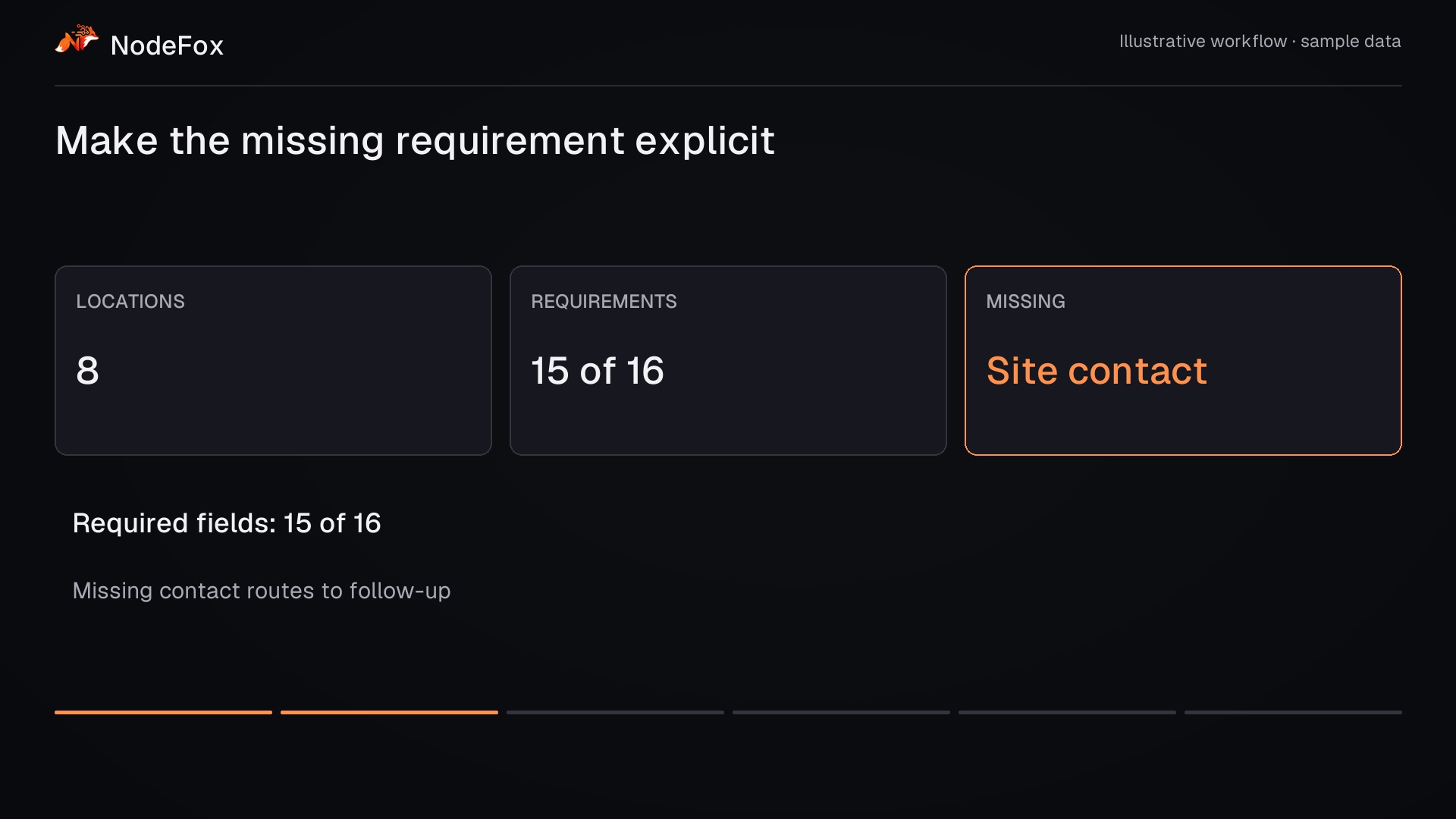
- 8–19s · Make the missing requirement explicit
Document interpretation and CRM checks assemble the packet. Fifteen of sixteen requirements are complete; setup waits for the missing contact.
Client: Meridian Field Services · Agreement: signed · Billing contact: supplied · Service locations: 8
- 19–28s · Carry context across departments
The workflow keeps account matching, completeness checks and the coordinator’s decision together. It avoids creating a duplicate account.
Intake folder · CRM · Service workspace
- 28–37s · Resolve the gap before setup
The coordinator receives the missing-item list. After the contact is supplied and checked, the workflow can prepare setup.
Coordinator receives missing-item list · Site contact supplied and checked · Approve client setup
- 37–46s · One record for finance and delivery
The completed handoff contains eight validated locations, prepared department tasks and a link to the original packet.
MFS-104 · ready for delivery · 8 validated service locations · Finance and delivery tasks prepared · Source packet linked to record
- 46–54s · Reuse the intake pattern
Measure follow-up touches and time to readiness. Reuse the validated intake pattern for the next client.
Client: Meridian Field Services · Agreement: signed · Billing contact: supplied · Service locations: 8
How much time goes into making a client ready?
Editable hypothetical example · USD
What could less coordination be worth?
Change four assumptions to estimate annual capacity. These are example inputs, not customer results. Calculations stay in your browser.
- Annual capacity potentially released
- 1,213.3 hours
- Annual labor-capacity equivalent
- $54,600
- Reduction in hands-on time
- 58.3%
2,080 cases / year × 35 minutes removed per case ÷ 60. Includes eligibility, exception effort and rework when entered.
Capacity is not automatically cash savings. Value depends on how the released time is used and what the workflow costs to operate.
Your systems stay the system of record.
- Onboarding inbox or client portalreadEmail attachments, portal exports or files in a watched folder.
- CRM — client records and signed scoperead + writeThrough its API. Writes are limited to creating the client record and gated.
- Requirements checklistreadA maintained table of required documents per service line.
- Team email or chatwriteThe delivery handoff and reviewer notifications. Optional.
People keep the decisions that matter.
Onboarding coordinator
Account lead
Process owner
Start with one service line
Pick the service line whose onboarding stalls most often. We run its real (or anonymised) packets through the checks, measure against your current handling and decide on production from the results.
Document classification and requirement checks for that service line
Missing-items reports and the reviewer step
CRM read access, plus a gated write path once you approve it
A baseline-versus-pilot scorecard
- Days to complete intake
- From first packet received to a complete, checked client record.
- Touches per client
- Follow-up requests and replies needed before intake is complete.
- Missing-item rate
- Share of packets with at least one missing or conflicting item, by document type.
- Handling minutes
- Hands-on time per packet, complete and incomplete packets separately.
Questions operations leaders ask
We already track onboarding in our CRM.
Every client sends documents differently.
Can it create or change client records on its own?
Packets contain tax and banking details.
For the technical review.
Which onboarding packets stall the longest?
Bring an incomplete intake packet. We’ll discuss the completeness checks, follow-up decisions and systems needed to make the client ready for service.