
Turn an AI answer into completed operational work.
NodeFox composes models, tools, code and human decisions in an executable graph. Coordinate the work around each model call: gather evidence, validate its shape, branch on the result and control downstream actions.
One executable workflow
Illustrative order flow · NodeFox coordinates the dependencies and decisions.
1. AI interprets
Read a purchase order or case note. Extract fields and prepare a structured proposal.
2. Tools retrieve
Get the account, transaction or policy context through configured APIs and permitted tools.
3. Code checks
Apply exact requirements, tolerances and transformations before an action can proceed.
4. People decide
Review the evidence and authorize decisions that need judgment. Missing information takes a defined path.
5. Systems act
Record the approved result in the destination system and inspect the run behind it.
One return request. A complete resolution process.
Synthetic example · A customer sends an unstructured return request
Return request to authorized resolution
Arrives
Return request R-108
- Order
- SO-8701: matched
- Requested
- 2 of 10 shipped units
- Delivered
- 8 days ago
Runs
Retrieve the customer message and attached invoice through configured access.
Extract order ID, items, quantities and the stated reason into structured fields.
A scoped API lookup returns shipped quantities, delivery date and prior returns.
Require an order match, remaining returnable quantity and a date inside the configured policy window.
The example policy allows 30 days; both units remain returnable. Routine action authorized by the configured rule.
Draft a response using checked facts; do not invent eligibility or authorize a refund.
Review the source, policy rule and proposed action before granting an exception.
Call the configured returns API with the checked quantities and an idempotency key.
Inspect inputs, checks, decision and destination response.
Synthetic teaching example. Model output is variable; the graph defines the checks and decisions around it. No model or external API is called here.
Result
Written
Return authorization recorded
- Checked quantities sent to the returns system
- Response prepared from confirmed facts
- No refund or other financial action implied
Work coordinated: input gathering, system lookups, repeated checks and approved updates. Select a step to inspect its role.
Human-owned: process rules, exception judgment and authorization. Synthetic records and transitions; no model calls or live system writes.
Make the surrounding work explicit.
Different models, one process
Configure extraction and drafting separately. Pass structured findings between them so the second task can use the first result without reconstructing context.
Exact checks in code
Validate required fields and source IDs before allowing the next step. A valid shape is one check; the reviewer still assesses evidence and correctness.
Controlled tool actions
Choose the API or browser MCP tools a step can use. Place consequential writes behind a condition or human decision with the required permissions.
Let an agent work with a process it can inspect and reuse.
Models and tools inside the workflow
Conversation steps call configured models. Compatible MCP servers can expose selected tools through the browser environment and its configured gateway. Validate tool results and control consequential actions with the surrounding graph.
External agents working with NodeFox
The supported MCP bridge exposes operations to read, inspect, modify and run networks in the connected workspace. Agent permissions, bridge authentication and the active environment determine which operations are available.
Headless invocation is a separate execution path. Verify supported steps, credentials and operator access for the intended runtime; browser MCP or OAuth configuration does not automatically transfer to a headless machine.
AI prepares the evidence. The workflow carries the decision.
Transcript and demonstration details
Illustrative execution, not a customer deployment. Narration is AI-generated. Actions and outputs depend on workflow configuration.
- 0–8s · A disputed credit needs evidence
A customer requests six hundred and twenty dollars for four missing units. The evidence spans three systems.
Investigation IN-530 · disputed credit · Order SO-301 · $6,200 · Customer reports 4 missing units · Credit request: $620
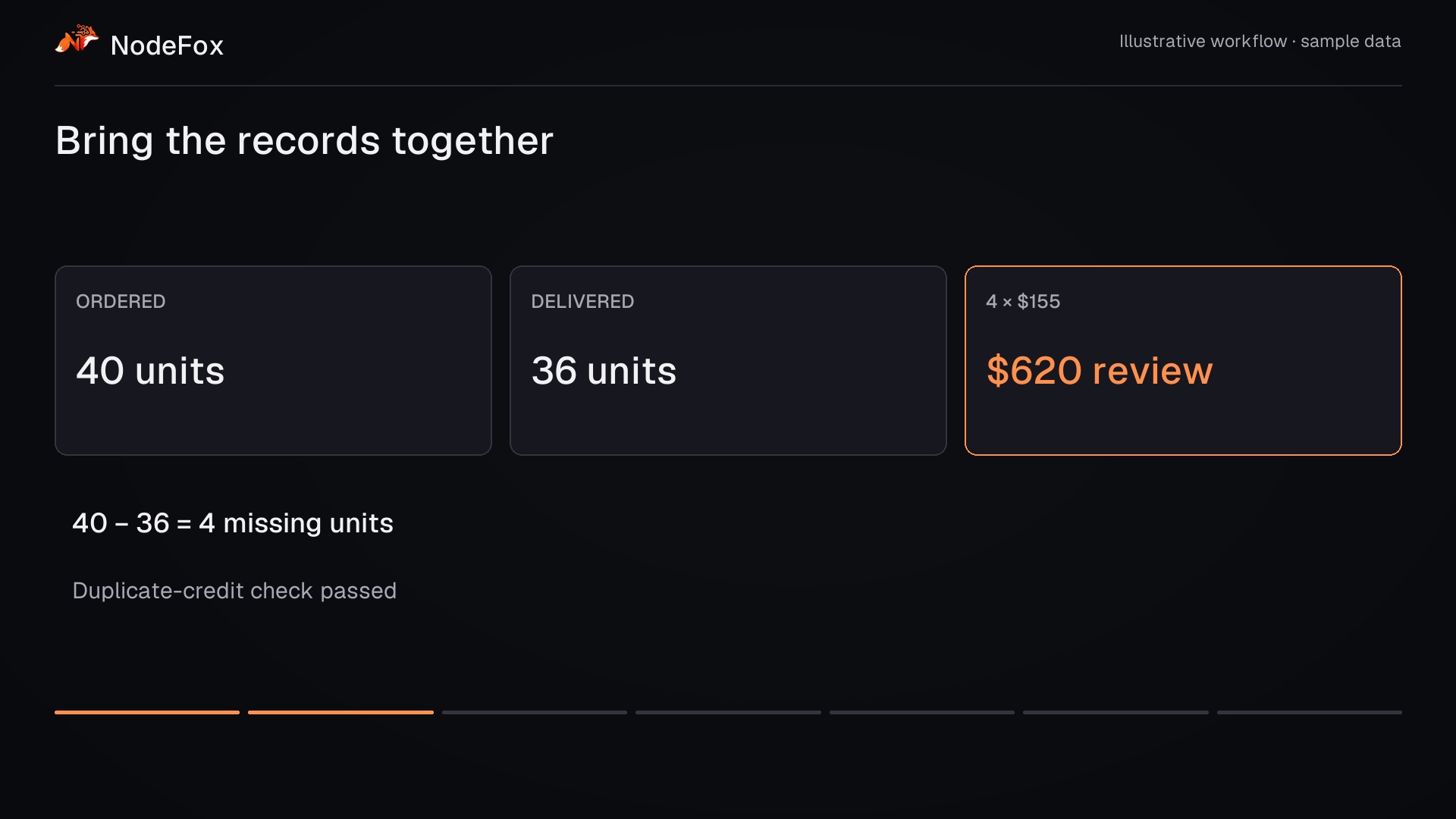
- 8–16s · Bring the records together
Readers retrieve order, shipment and credit records. AI organizes the evidence for exact checks.
Order: 40 units at $155 · Shipment: 36 delivered · Credit ledger: no prior credit
- 16–27s · Test the explanation
Forty ordered. Thirty-six delivered. Four missing units at one hundred fifty-five dollars supports the claim. No earlier credit exists.
40 − 36 = 4 missing units · 4 × $155 = $620 supported · Duplicate-credit check passed
- 27–35s · Carry evidence into the decision
The graph connects source records, arithmetic and review. The recommendation follows an explicit decision.
Order history · Shipment events · Credit ledger
- 35–42s · Authorize the recommendation
The reviewer approves the credit recommendation. Finance retains posting authority.
Reviewer sees evidence and arithmetic · Approve credit recommendation · Finance retains posting authority
- 42–50s · An investigation report you can explain
The investigation report carries the amount, sources and decision history. It does not claim a credit was posted.
IN-530 · investigation report · Supported recommendation: $620 · Sources: order, shipment, credit log · Decision and execution history linked
- 50–56s · Inspect the record, do not repeat the action
Review stored evidence. A new execution can repeat external actions.
Investigation IN-530 · disputed credit · Order SO-301 · $6,200 · Customer reports 4 missing units · Credit request: $620
Design the graph. Follow the work.
Illustrative NodeFox interface and synthetic data. This local walkthrough explains the graph; it does not call AI, run the NodeFox engine or update external systems.
- Reference
- CASE-104
- Amount (sample USD)
- 1200
Reader → model interpretation → Data mapping and Code check → human Decision → activated Writer.
Ready to explore
Inspect the input, then run the checks. The Writer remains behind the Decision step. A required reference must be present before review.
Measure the whole task, including review.
Baseline
Operating cost
Reuse
Prerequisites
Does the graph guarantee that a model is correct?
Can we use an existing agent?
Can this run headlessly?
Value the handoffs between systems.
Editable hypothetical example · USD
What could less coordination be worth?
Change four assumptions to estimate annual capacity. These are example inputs, not customer results. Calculations stay in your browser.
- Annual capacity potentially released
- 1,950 hours
- Annual labor-capacity equivalent
- $87,750
- Reduction in hands-on time
- 60%
13,000 cases / year × 9 minutes removed per case ÷ 60. Includes eligibility, exception effort and rework when entered.
Capacity is not automatically cash savings. Value depends on how the released time is used and what the workflow costs to operate.
Bring the workflow around your models into view.
Discuss the inputs, tools, controls and result you need—or start building the graph yourself.