
A support answer needs context from more than a ticket.
Support staff gather order history, check policy and coordinate back-office actions before replying to a customer. NodeFox connects the input, reference checks and human decision in one executable workflow.
Interpret the input. Establish the facts. Control the action.
AI interprets
- Intent: damaged delivery
- Item: pump housing PH-8
- Proposed outcome: replacement
Systems provide context
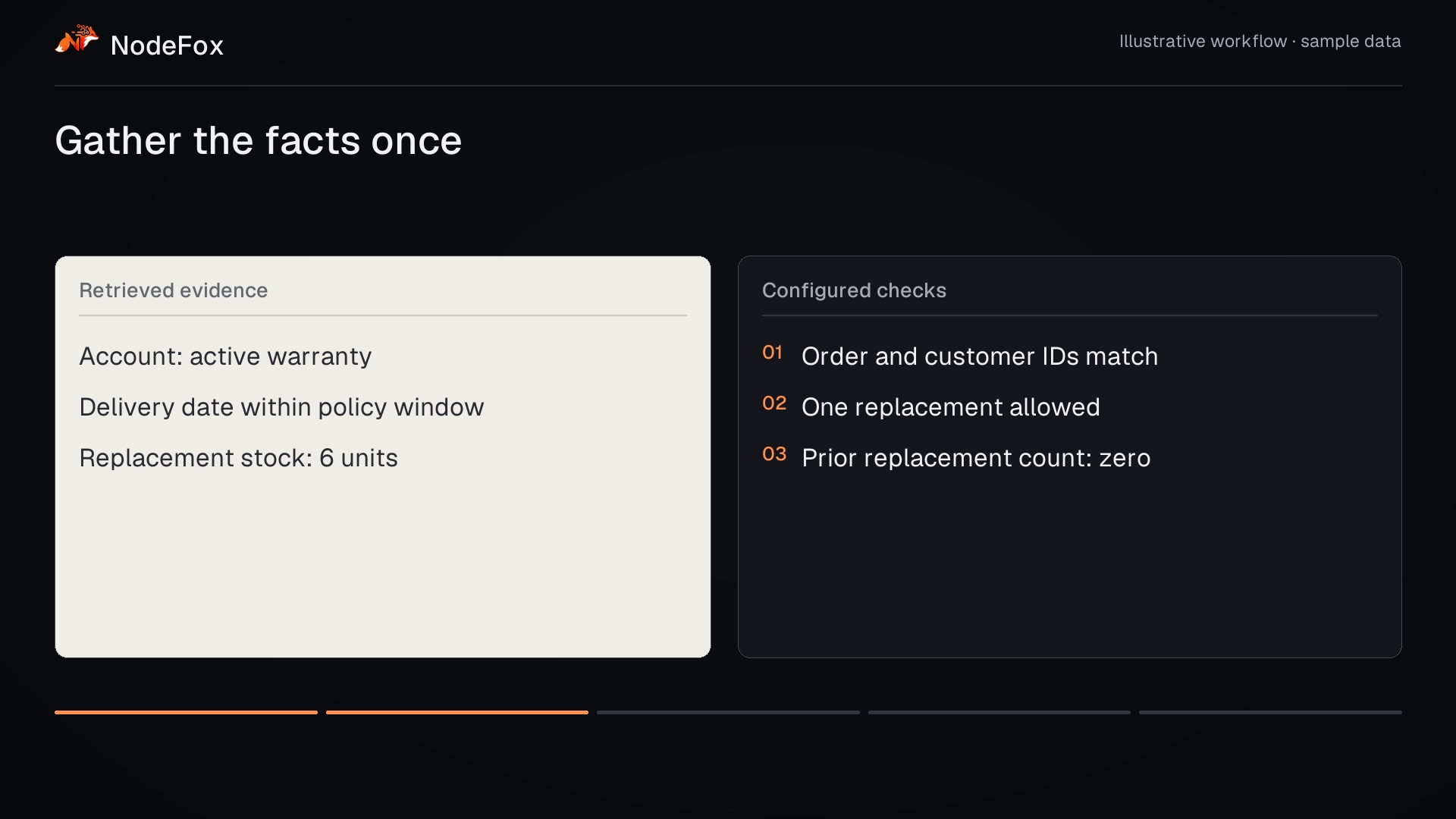
- Account: active warranty
- Delivery date within policy window
- Replacement stock: 6 units
Code applies exact checks
- Order and customer IDs match
- One replacement allowed
- Prior replacement count: zero
People retain the decision
- Agent reviews evidence and draft
- Approve replacement request
- Customer response follows approval
What proceeds—and what waits
A request within the replacement policy can proceed to the configured resolution path.
A conflicting entitlement or refund request stays with the service owner; the example does not authorize a refund.
Raw input → usable output
Resolve the case without repeating the investigation.
The support owner receives a resolution grounded in the order and policy, with the proposed replacement linked to the case.
- Input 1
- Ticket CS-918 · damaged item
- Input 2
- Customer: Westport Workshop
- Input 3
- Order SO-4428 · delivered Nov 1
- Input 4
- Request: replacement
CS-918 · resolution prepared
- replacement request
- RPL-207
- refund authorized
- No
- status
- resolution prepared
Decision attached
Approve replacement request
Source references and configured checks accompany the result.
Inspect the structured record
{
  "ticket_id": "CS-918",
  "replacement_request": "RPL-207",
  "refund_authorized": false,
  "status": "resolution_prepared"
}Synthetic sample files with inputs, checks and decisions. System updates require configured access and authorization. Documents and reports depend on the chosen Writer format and template.
Resolve the case without repeating the investigation.
Transcript and demonstration details
Illustrative execution, not a customer deployment. Narration is AI-generated. Actions and outputs depend on workflow configuration.
- 0–8s · A replacement request needs context
A customer reports a damaged item. A useful response needs the order, warranty and replacement history.
Ticket CS-918 · damaged item · Customer: Westport Workshop · Order SO-4428 · delivered Nov 1 · Request: replacement
- 8–17s · Gather the facts once
Readers retrieve the account and delivery records. The warranty is active, stock is available, and no prior replacement exists.
Account: active warranty · Delivery date within policy window · Replacement stock: 6 units
- 17–27s · Apply the policy before proposing action
AI classifies the request. Exact rules check identity and eligibility before a response reaches the support agent.
Support queue · Customer CRM · Order service
- 27–37s · Review the proposed response
The agent reviews the evidence and authorizes a replacement request. The proposed customer response remains visible for approval.
Agent reviews evidence and draft · Approve replacement request · Customer response follows approval
- 37–47s · A resolution the team can act on
The ticket now has a prepared replacement request and approved response. Dispatch confirmation and sending remain separate next steps.
CS-918 · resolution prepared · Replacement request: RPL-207 · Ticket linked to source order · Approved response ready to send
What could customer support operations release?
Editable hypothetical example · USD
What could less coordination be worth?
Change four assumptions to estimate annual capacity. These are example inputs, not customer results. Calculations stay in your browser.
- Annual capacity potentially released
- 1,733.3 hours
- Annual labor-capacity equivalent
- $69,333
- Reduction in hands-on time
- 57.1%
13,000 cases / year × 8 minutes removed per case ÷ 60. Includes eligibility, exception effort and rework when entered.
Capacity is not automatically cash savings. Value depends on how the released time is used and what the workflow costs to operate.
Measure the work removed—and the quality that remains.
- Investigation minutes per ticket
- Back-office touches
- Resolution quality
Start with one customer support operations process.
Access, ownership and acceptance
Read the ticket, source order and approved policy. Scope replacement requests and ticket updates separately from refunds or outbound messages.
- Support queue
- Customer CRM
- Order service
Name the process owner and technical operator. Agree acceptance criteria and costs before implementation. A successful evaluation leads to recurring platform use; proven connections and checks can support the next workflow. When feasibility is already established, scope production directly.
Is this work your team keeps coordinating?
Bring the current steps, systems and approximate volume. Discuss customer support operations, what would remain human-owned and whether a paid implementation makes sense.